
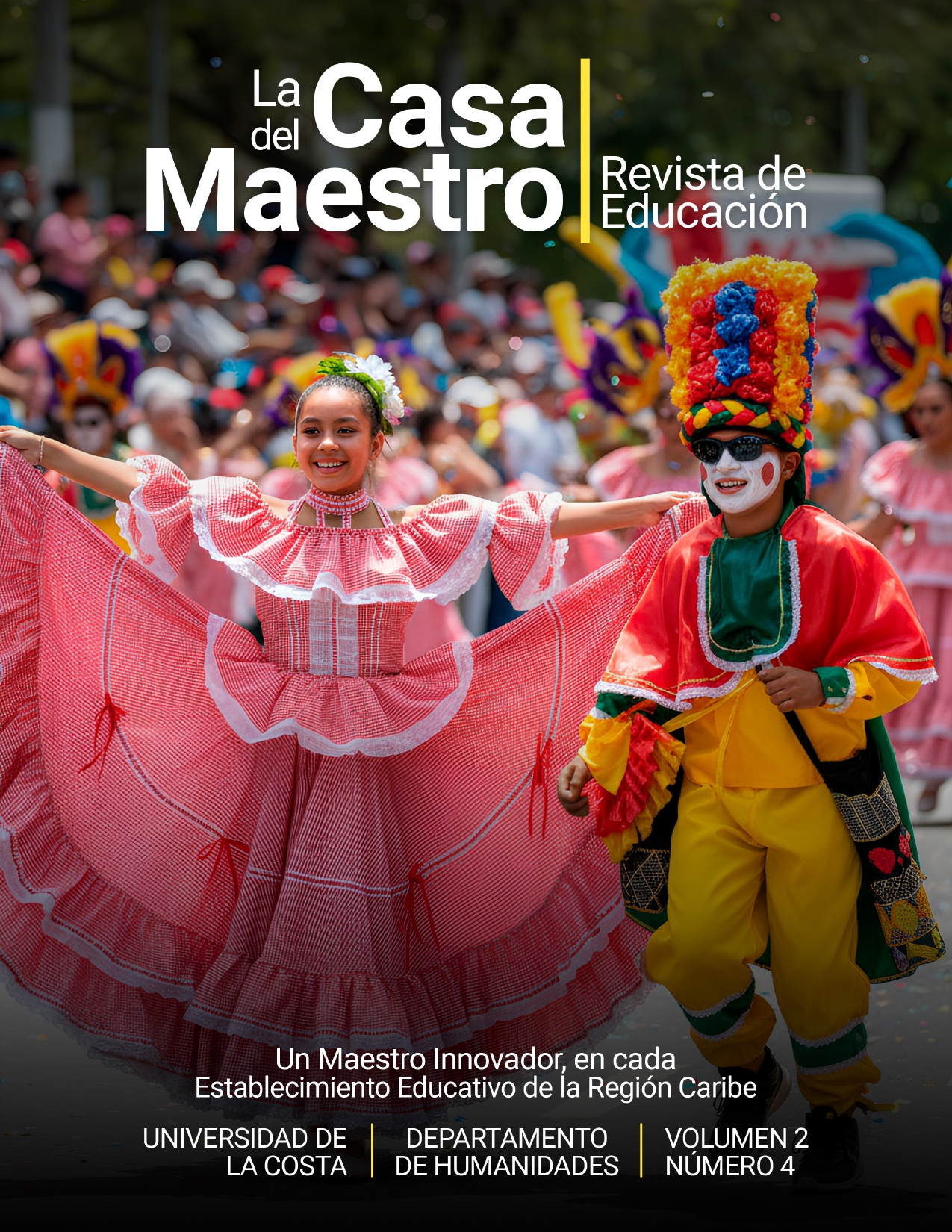
Emotional and cultural symbols of Carnival that are perpetuated in the relationship between Community and School.
##plugins.themes.bootstrap3.article.sidebar##
##plugins.themes.bootstrap3.article.main##
Abstract
This article analyzes the Barranquilla Carnival as a formative experience in childhood through the use of symbolic cartographies with color codes created by participating children. The main objective is to understand the meaning of the carnival in children's imaginaries and its impact on the construction of cultural identity from a pedagogical, artistic, and sociocultural perspective. A qualitative methodology with an ethnographic approach was used, employing semi-structured interviews, creative workshops, and participatory mapping as core data collection tools.
Key findings highlight the configuration of a collective affective memory in children's drawings, which reveal a symbolic appropriation of festive spaces, the creation of personal narratives, and the incorporation of traditional elements into their imagination. These emotional maps, rich in color, movement, and symbols, demonstrate how children reinterpret the carnival through their everyday
experiences and emotional bonds, producing discourses that strengthen their sense of belonging and connection to the territory. Moreover, the carnival is identified as a space for intergenerational transmission of knowledge, where cultural practices are inherited, adapted, and re-signified from an early age.
This festive experience not only stimulates creativity but also becomes a non-formal educational space that fosters civic formation, identity construction, and social cohesion. Despite its local scope and limited sample drawn from specific neighborhoods in Barranquilla, the study provides a deep and situated reading of the carnival from the perspective of childhood.
This research proposes a new way to interpret the festive space as a pedagogical, symbolic, and emotional territory where children not only participate but also narrate, represent, and collectively recreate their culture. Thus, it contributes to the understanding of the carnival as a complex phenomenon that integrates art, memory, education, and identity.
Downloads
##plugins.themes.bootstrap3.article.details##
Los artículos publicados son de exclusiva responsabilidad de sus autores y no reflejan necesariamente las opiniones del comité editorial.
La Revista LA CASA DEL MAESTRO respeta los derechos morales de sus autores, los cuales ceden al comité editorial los derechos patrimoniales del material publicado. A su vez, los autores informan que el presente trabajo es inédito (original) y no ha sido publicado anteriormente.
Contrato de cesión de derechos patrimoniales de autor
Formato de certificación de originalidad del artículo por parte del autor
La revista LA CASA DEL MAESTRO se guía por las normas internacionales sobre propiedad intelectual y derechos de autor, y de manera particular por el artículo 58 de la Constitución Política de Colombia, la Ley 23 de 1982 y la ley 1915 de 2018.