
Inflation targeting and interest rate in Colombia, 2005-2023
##plugins.themes.bootstrap3.article.sidebar##
##plugins.themes.bootstrap3.article.main##
 https://orcid.org/0000-0002-4471-0931
Abstract
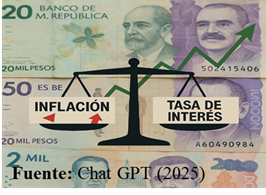
This article analyzes monetary policy in Colombia, emphasizing the inflation targeting strategy and the role of the Central Bank as the central regulatory authority. During 2021 and 2022, the Colombian economy faced strong pressures stemming from the global context resulting from the post-pandemic situation, which created significant challenges for macroeconomic stability. In response to this situation, the Banco de la República decided to adopt alternative measures to traditional intervention rate increases, prioritizing mechanisms aimed at limiting capital inflows and private sector external debt. The article examines the effects of the intervention rate on inflation in the period 2005–2023, using a structural Vector Autoregression with exogenous variables (VAR-X) model. It highlights the need to incorporate both internal and external factors into monetary policy decision-making, given the growing degree of global economic interdependence. The findings highlight that, beyond rate adjustments, it is essential to implement complementary measures that reduce vulnerability to external shocks, ensuring a more comprehensive and effective response to inflationary pressures.
Downloads
##plugins.themes.bootstrap3.article.details##

This work is licensed under a Creative Commons Attribution-NonCommercial-NoDerivatives 4.0 International License.
You are free to:
- Share — copy and redistribute the material in any medium or format
- The licensor cannot revoke these freedoms as long as you follow the license terms.
Under the following terms:
- Attribution — You must give appropriate credit , provide a link to the license, and indicate if changes were made . You may do so in any reasonable manner, but not in any way that suggests the licensor endorses you or your use.
- NonCommercial — You may not use the material for commercial purposes .
- NoDerivatives — If you remix, transform, or build upon the material, you may not distribute the modified material.
- No additional restrictions — You may not apply legal terms or technological measures that legally restrict others from doing anything the license permits.