
Bioethical Approaches to Smart Agriculture: A Reflection on Justice, Autonomy, Sustainability, and Vulnerability
##plugins.themes.bootstrap3.article.sidebar##
##plugins.themes.bootstrap3.article.main##
 https://orcid.org/0000-0001-7890-7751
Abstract
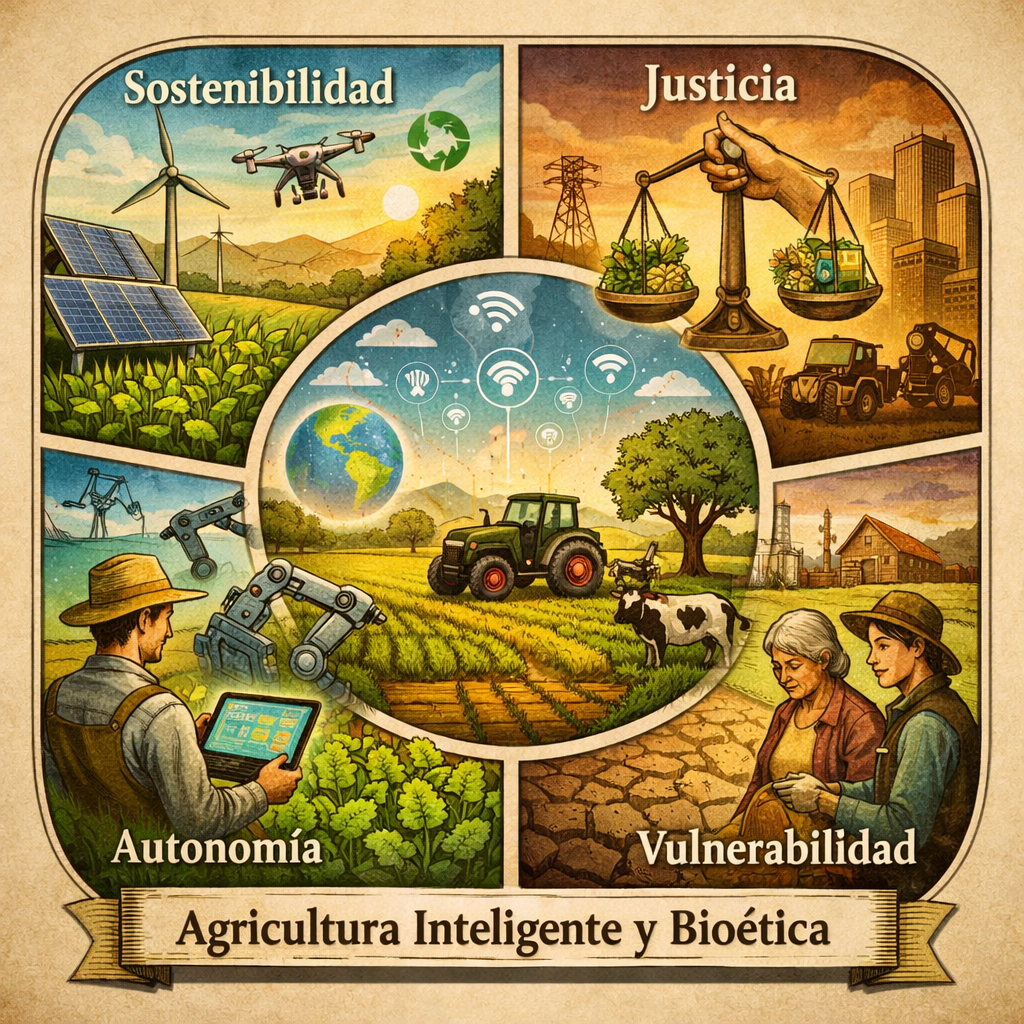
Smart agriculture has transformed the agri-food landscape through technologies such as sensors, artificial intelligence, robotics, and big data, all of which promise greater efficiency and sustainability. However, this digital revolution is not free of ethical dilemmas. This reflective article analyzes international scientific studies published between 2014 and 2024, with the aim of identifying the main bioethical categories present in the literature on smart agriculture. The analysis revealed four predominant bioethical categories: sustainability, justice, vulnerability, and autonomy. While technological discourse emphasizes environmental efficiency, deep inequalities persist in terms of access, appropriation, and technological design. Groups such as small-scale producers, rural women, and disconnected communities face structural barriers that limit their active participation in this transformation process. The findings confirm that the digitalization of agriculture is neither a neutral process nor universally beneficial. Advancing toward a truly ethical and sustainable agriculture requires governance frameworks that recognize all involved actors—both human and non-human—as ethical subjects, ensuring their agency, well-being, and justice throughout every phase of technological development.
Downloads
##plugins.themes.bootstrap3.article.details##

This work is licensed under a Creative Commons Attribution-NonCommercial-NoDerivatives 4.0 International License.
You are free to:
- Share — copy and redistribute the material in any medium or format
- The licensor cannot revoke these freedoms as long as you follow the license terms.
Under the following terms:
- Attribution — You must give appropriate credit , provide a link to the license, and indicate if changes were made . You may do so in any reasonable manner, but not in any way that suggests the licensor endorses you or your use.
- NonCommercial — You may not use the material for commercial purposes .
- NoDerivatives — If you remix, transform, or build upon the material, you may not distribute the modified material.
- No additional restrictions — You may not apply legal terms or technological measures that legally restrict others from doing anything the license permits.