
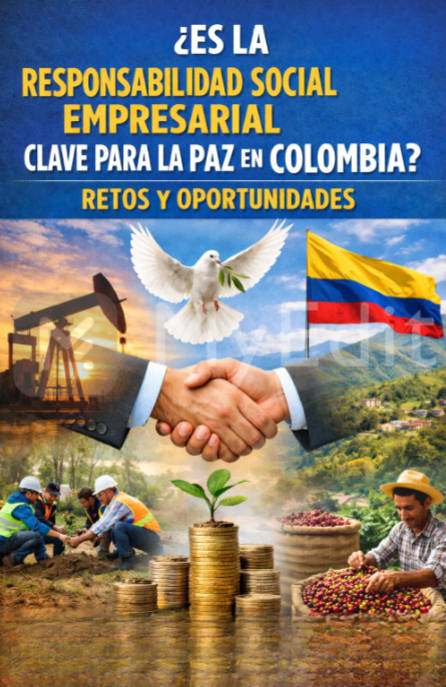
Is corporate social responsability key to peace in Colombia? Challenges and opportunities
##plugins.themes.bootstrap3.article.sidebar##
##plugins.themes.bootstrap3.article.main##
 https://orcid.org/0000-0002-4568-0690
Abstract
This study analyzes the challenges and opportunities of Corporate Social Responsibility (CSR) in the context of peacebuilding in Colombia, considering the post-conflict scenario with the defunct FARC guerrilla group and the challenges posed by the Peace Agreement for the country. To this end, a qualitative methodological design was employed in two stages: a systematic review of the literature on CSR and peace (from academic production between 2019 and 2025 and available in English or Spanish were considered) in the databases Scopus, Web of Science, and Taylor & Francis; and a content analysis of the sustainability reports of four leading Colombian companies, supported by Atlas.ti software. The results confirm a growing trend in academic production, but also a fragmentation of the field of study. Colombia's leading role is evident, ranking fifth worldwide in publications on the topic, reflecting the relevance of the post-agreement period. Comparing academic discourse with business practices reveals a significant gap. While reports from companies such as Éxito and Terpel disclose workforce inclusion initiatives, these are presented in a fragmented manner and with a reputational focus, lacking the multisectoral coordination and accountability necessary for transformative impact. The study concludes that, while CSR is crucial for peace, its implementation in the Colombian context must transcend, adopting a transformative vision that integrates stakeholders from across the entire social fabric, seeking greater positive impact.
Downloads
##plugins.themes.bootstrap3.article.details##

This work is licensed under a Creative Commons Attribution-NonCommercial-NoDerivatives 4.0 International License.
You are free to:
- Share — copy and redistribute the material in any medium or format
- The licensor cannot revoke these freedoms as long as you follow the license terms.
Under the following terms:
- Attribution — You must give appropriate credit , provide a link to the license, and indicate if changes were made . You may do so in any reasonable manner, but not in any way that suggests the licensor endorses you or your use.
- NonCommercial — You may not use the material for commercial purposes .
- NoDerivatives — If you remix, transform, or build upon the material, you may not distribute the modified material.
- No additional restrictions — You may not apply legal terms or technological measures that legally restrict others from doing anything the license permits.