
Tug of War: The definition of the rules for freedom of expression on social networks
##plugins.themes.bootstrap3.article.sidebar##
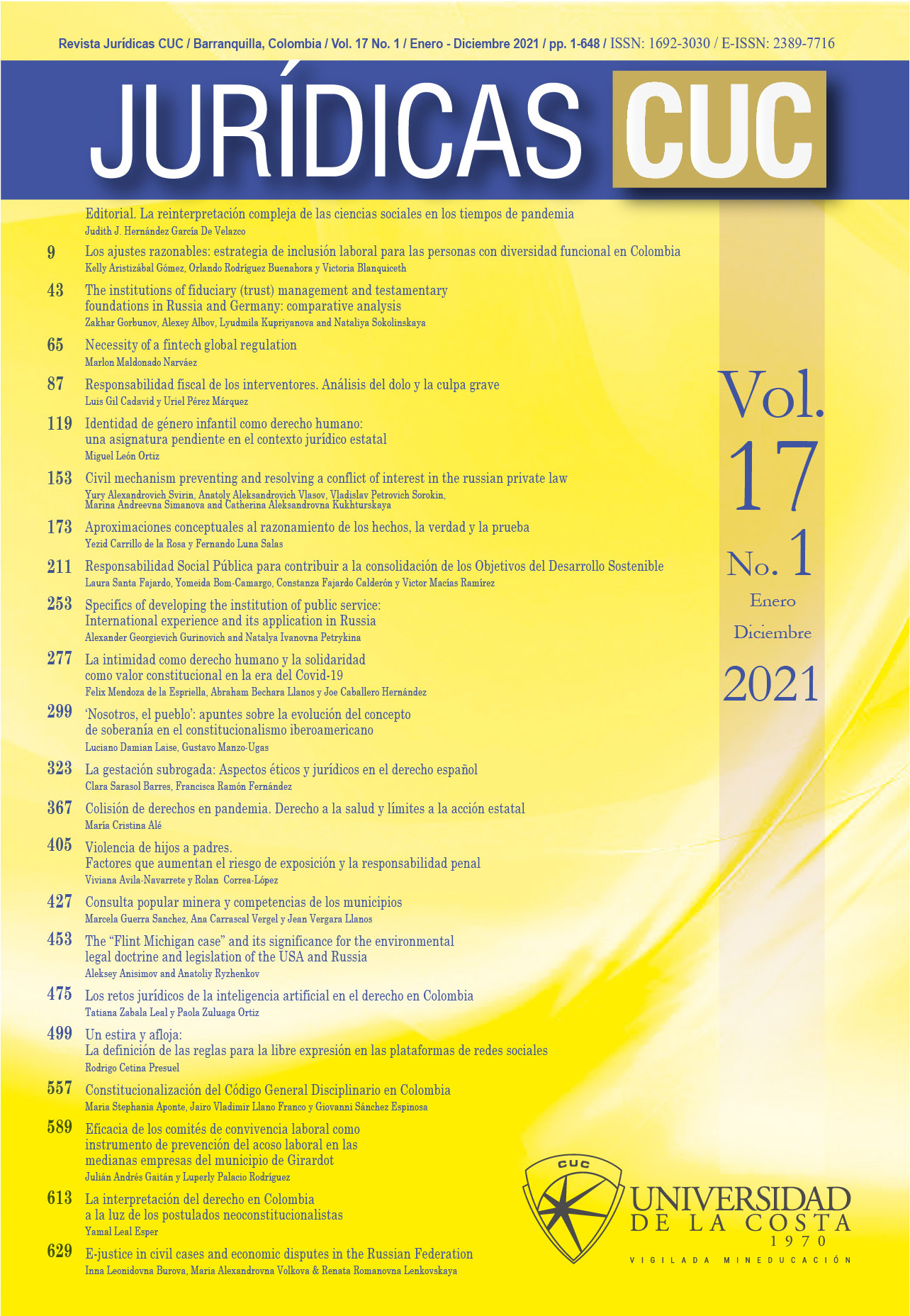
##plugins.themes.bootstrap3.article.main##
 https://orcid.org/0000-0002-1061-0166
Abstract
This work studies the rules for freedom of expression in social networks to identify two contradicting trends. A judicial trend inside the European Union (EU) that seeks to apply local freedom of expression rules globally to better protect the rights of those who suffer infringements online. A second, contradicting trend, also within the EU, of adopting laws that delegate the enforcement of online freedom of expression to social media platforms. This reveals that social networks seek to accelerate this trend through the adoption of private schemes to solve controversies related to content moderation in an attempt to legitimize their private rules and show that they are enough to guarantee fundamental rights online and thus, fend off future governmental initiatives to impose stricter regulations on them. In terms of methodology, the work analyzes examples from the Court of Justice of the European Union, from EU legislative initiatives and from the so-called Facebook Oversight Board. The goal is to analyze those trends to highlight their negative consequences. The main contribution of this work is to show that these trends only benefit social media platforms in the sense that they allow the platforms to strengthen their position as private regulators of online freedom of expression through their own unilaterally adopted rules and for the benefit of their business model. As we argue in our conclusions, this has a negative impact on freedom of expression, which finds itself subject to these standardized rules and to a false universalization of this right.
Downloads
##plugins.themes.bootstrap3.article.details##

This work is licensed under a Creative Commons Attribution-NonCommercial-NoDerivatives 4.0 International License.
The authors are exclusively responsible for the published articles, which do not necessarily reflect the views of the editorial committee.
JURIDICAS CUC respects the moral rights of authors who have assigned the property rights on the published materials to the editorial committee. In turn, the authors declare that the work they submit has not been previously published.