
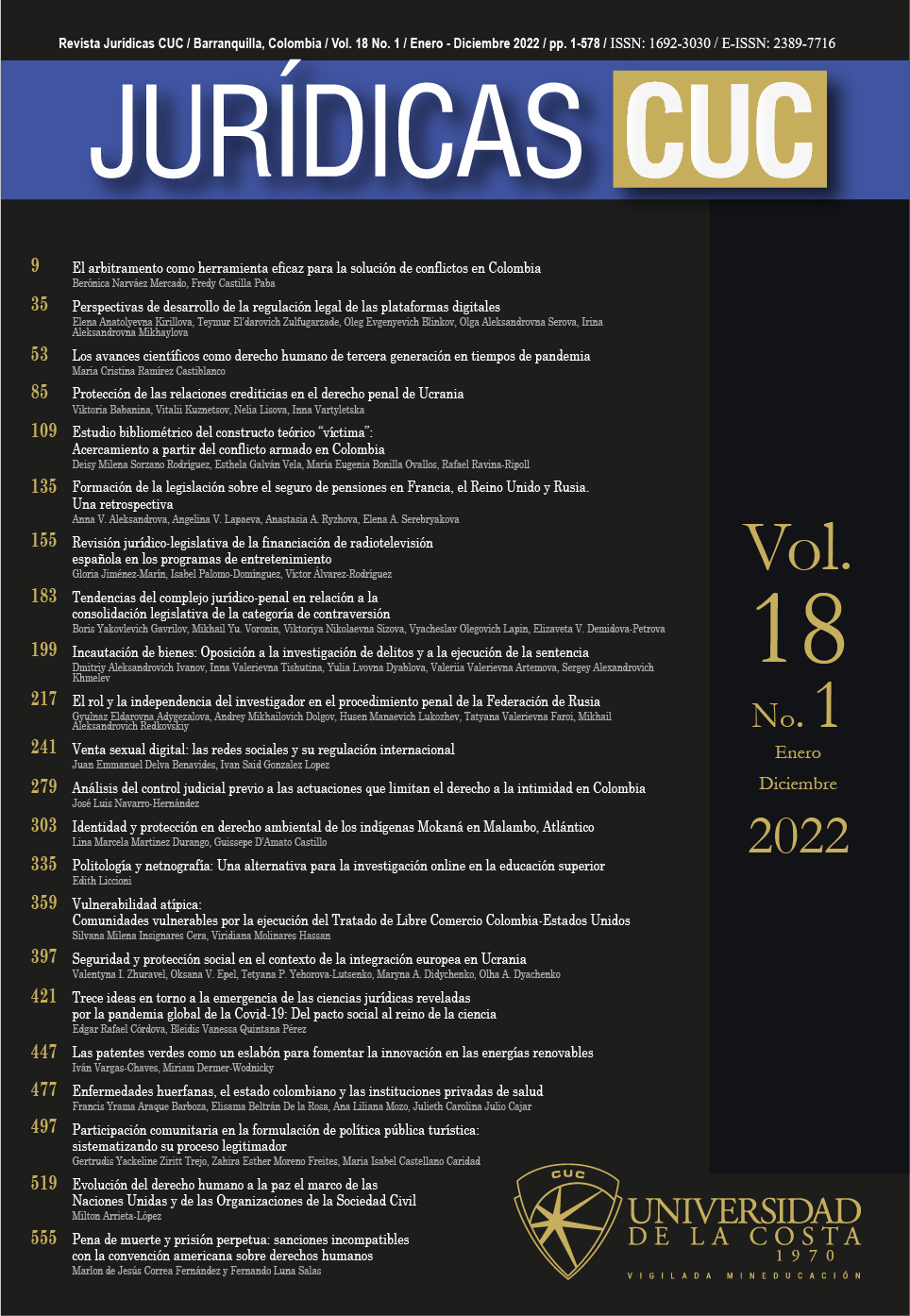
Scientific advances as a third-generation human right in times of pandemic
##plugins.themes.bootstrap3.article.sidebar##
##plugins.themes.bootstrap3.article.main##
 https://orcid.org/0000-0003-2918-5056
Abstract
The pandemic caused by the Covid-19 virus has pose a threat to humanity, forcing the entire world to implement measures of distancing and social isolation and has been a terrible blow to the planet’s economy and public health. Large pharmaceutical companies around the world financed, on many occasions, with public money, were braided in a runaway race to get a vaccine that could return the planet to the hoped normality, leaving their coffers full. This paper analyzes the consequences of preventing the release of the patent for this vaccine in relation to the human right to use advances in science and technology. Using a qualitative methodology, with a descriptive, correlational and explanatory scope, based on a review of the literature, the opposition that occurs between the rights of peoples to receive the Covid-19 vaccine, as part of the right to use, is evidenced. of the advances of science and technology in its capacity as a third generation human right, and the interests of large pharmaceutical companies and private business conglomerates, in the light of Law, ethics and public health, discerning on a controversial issue that has humanity in suspense. It is concluded that what is at stake goes beyond economic interests, since those who own and maintain ownership of patents will have an advantage in terms of geopolitics and, incidentally, greater control over biopolitics.
Downloads
##plugins.themes.bootstrap3.article.details##

This work is licensed under a Creative Commons Attribution-NonCommercial-NoDerivatives 4.0 International License.
The authors are exclusively responsible for the published articles, which do not necessarily reflect the views of the editorial committee.
JURIDICAS CUC respects the moral rights of authors who have assigned the property rights on the published materials to the editorial committee. In turn, the authors declare that the work they submit has not been previously published.