
Evaluación de subproductos de aceite de palma (Elaeis guineensis) como bioadsorbentes para la eliminación de nitritos, fosfatos y sulfatos en aguas residuales domésticas
Barra lateral del artículo
Contenido principal del artículo
Resumen
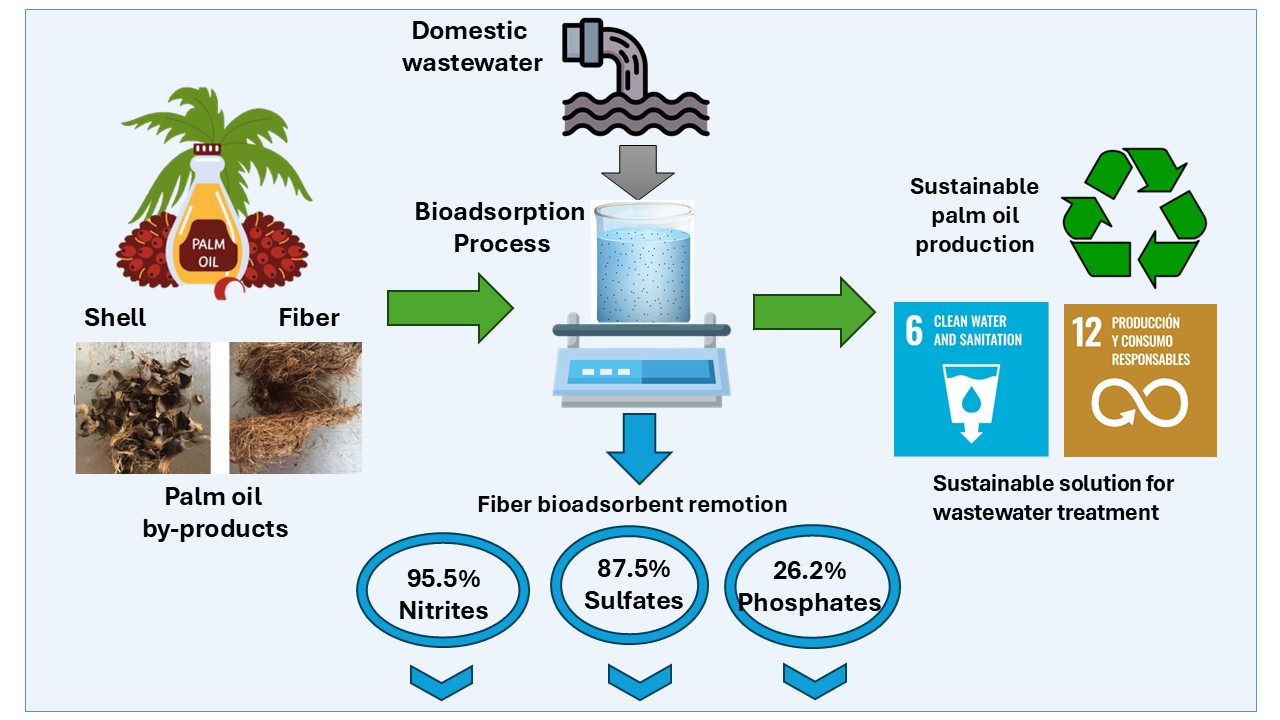
La creciente preocupación mundial por la sostenibilidad ambiental ha impulsado la búsqueda de soluciones eficientes en el tratamiento de aguas residuales. En este estudio se evaluó el potencial de los subproductos del aceite de palma (Elaeis guineensis), específicamente la cáscara y la fibra, como adsorbentes para la remoción de nitritos, fosfatos y sulfatos de las aguas residuales domésticas. La eficiencia de remoción de nutrientes se determinó mediante espectrofotometría. Se evaluó el efecto de variables operativas como el tipo y la cantidad de material bioadsorbente y el tiempo de contacto sobre la eficiencia de remoción de estos contaminantes. Los resultados indicaron que la fibra exhibió una alta capacidad de adsorción, removiendo el 95.55% de nitritos, el 87.50% de sulfatos y 26.2% de fosfatos. Estos hallazgos sugieren que los subproductos del aceite de palma ofrecen una solución rentable y sostenible para el tratamiento de aguas residuales, particularmente en países como Colombia, contribuyendo al logro de los Objetivos de Desarrollo Sostenible (ODS) de las Naciones Unidas para 2030, específicamente el ODS 6 y el ODS 12, meta 6.3, que se centran en mejorar la calidad del agua reduciendo la contaminación y minimizando la liberación de sustancias peligrosas
Descargas
Detalles del artículo

Esta obra está bajo una licencia internacional Creative Commons Atribución-NoComercial-SinDerivadas 4.0.

Usted es libre de:
- Compartir — copiar y redistribuir el material en cualquier medio o formato
- La licenciante no puede revocar estas libertades en tanto usted siga los términos de la licencia
Bajo los siguientes términos:
- Atribución — Usted debe dar crédito de manera adecuada , brindar un enlace a la licencia, e indicar si se han realizado cambios . Puede hacerlo en cualquier forma razonable, pero no de forma tal que sugiera que usted o su uso tienen el apoyo de la licenciante.
- NoComercial — Usted no puede hacer uso del material con propósitos comerciales .
- SinDerivadas — Si remezcla, transforma o crea a partir del material, no podrá distribuir el material modificado.
- No hay restricciones adicionales — No puede aplicar términos legales ni medidas tecnológicas que restrinjan legalmente a otras a hacer cualquier uso permitido por la licencia.
Link: https://creativecommons.org/licenses/by-nc-nd/4.0/deed.es