
Energy Transition and Expansion of Renewable Energies
Barra lateral del artículo
Contenido principal del artículo
Resumen
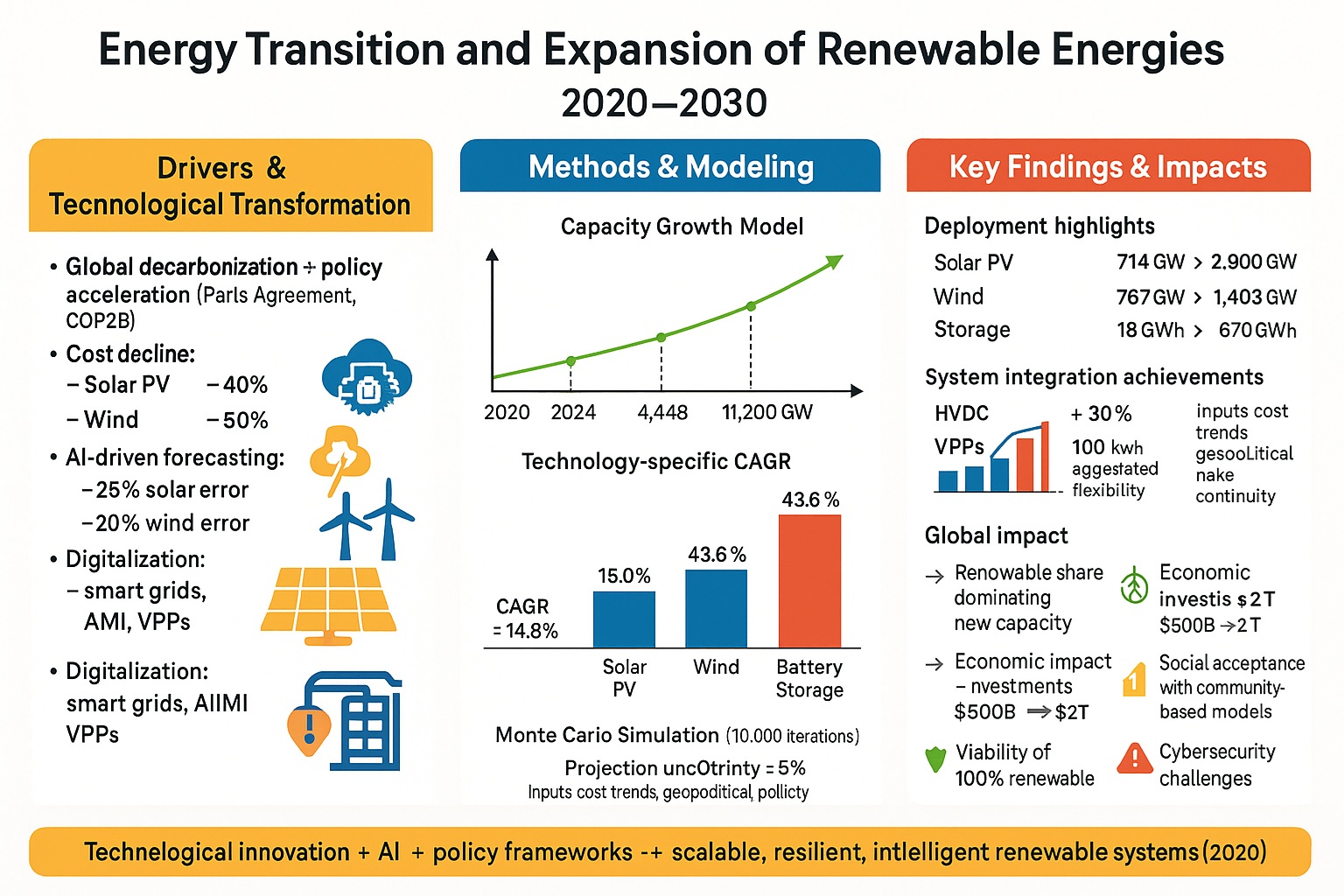
The global energy transition has reached a critical inflection point, observed alongside the convergence of artificial intelligence, innovative energy storage solutions, and cross-sector system integration. This study analyzes significant progress in renewable energy deployment from 2020 to 2030, examining technological advances, economic factors, and policy frameworks that are transforming previously challenging scenarios into scalable realities. Through detailed analysis of global capacity data, cost trends, and regional deployment patterns, this research highlights the evolution of the energy transition into an intelligent, data-oriented infrastructure transformation extending beyond the energy sector. Key findings indicate global renewable energy capacity increasing from approximately 2,800 GW in 2020 to 11,200 GW by 2030, with solar photovoltaic technology expanding at a compound annual growth rate (CAGR) of 15.0%. Battery storage deployment correlates with substantial growth at a CAGR of 43.6%, while costs for renewable technologies, such as solar PV, decline approximately 40% during the decade. The study concludes that technological maturity, economic competitiveness, and enhanced system integration now correlate with the technical feasibility and economic viability of 100% renewable energy systems globally
Descargas
Detalles del artículo

Esta obra está bajo una licencia internacional Creative Commons Atribución-NoComercial-SinDerivadas 4.0.

Usted es libre de:
- Compartir — copiar y redistribuir el material en cualquier medio o formato
- La licenciante no puede revocar estas libertades en tanto usted siga los términos de la licencia
Bajo los siguientes términos:
- Atribución — Usted debe dar crédito de manera adecuada , brindar un enlace a la licencia, e indicar si se han realizado cambios . Puede hacerlo en cualquier forma razonable, pero no de forma tal que sugiera que usted o su uso tienen el apoyo de la licenciante.
- NoComercial — Usted no puede hacer uso del material con propósitos comerciales .
- SinDerivadas — Si remezcla, transforma o crea a partir del material, no podrá distribuir el material modificado.
- No hay restricciones adicionales — No puede aplicar términos legales ni medidas tecnológicas que restrinjan legalmente a otras a hacer cualquier uso permitido por la licencia.
Link: https://creativecommons.org/licenses/by-nc-nd/4.0/deed.es