
Theoretical approach to accompaniment strategies in the family and school environment
Article Sidebar
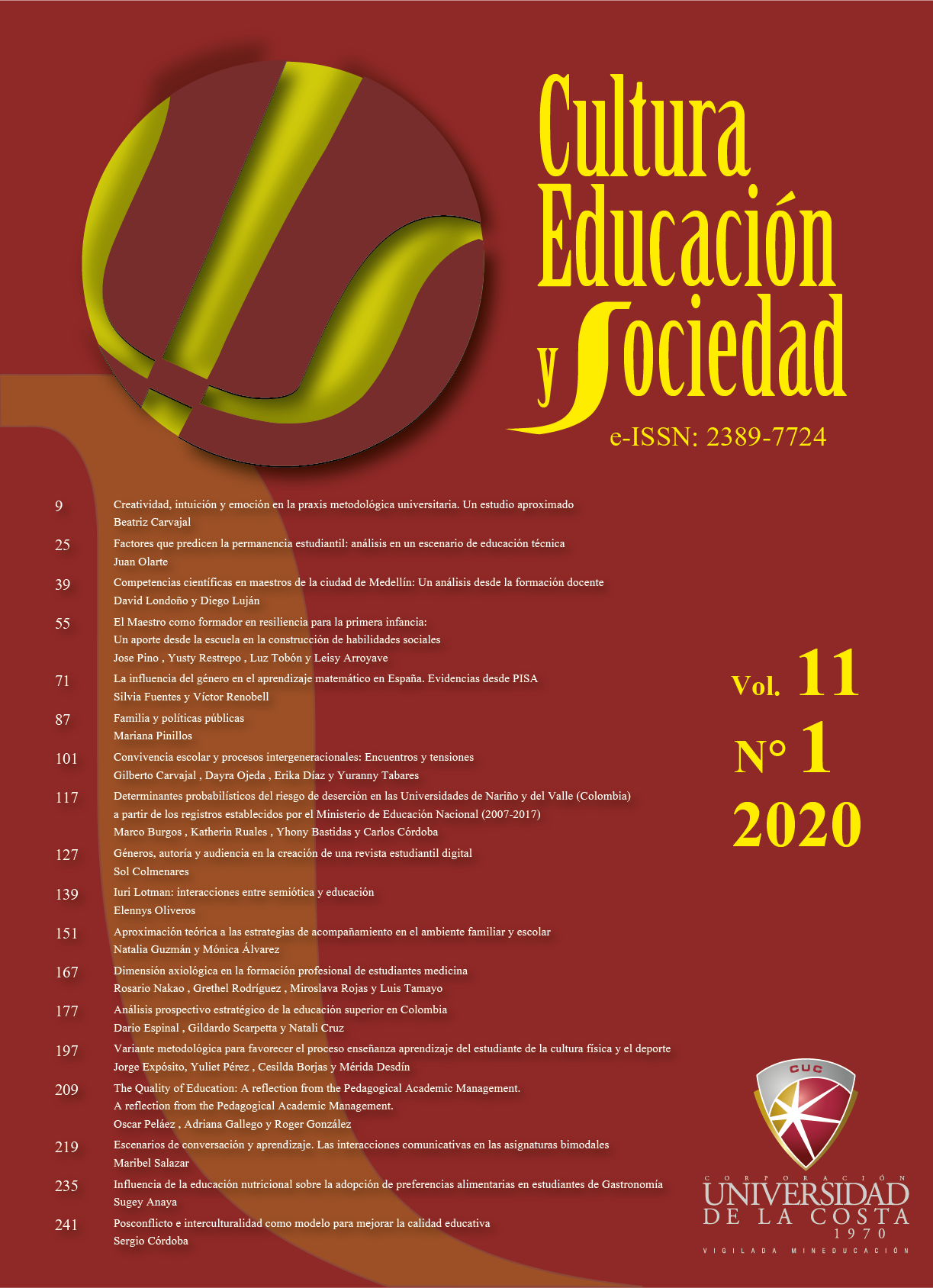
Main Article Content
Abstract
The objective of this review article is to approach the state of the art as a basis for the advancement of scientific knowledge, in relation to the accompaniment strategies that are applied in the family and school environment during the growth and development of children. For this, we work with the technique of systematic review of documentary sources deposited in repositories of libraries, indexed journals and various databases where the quantity and quality of the information related to the identified constructs is analyzed. The results show that the accompaniment strategies are presented as a relevant factor in the family and school environment; their characteristics make them co-responsible in the process of child development. It is concluded that each environment is a teaching and learning space, so it requires accompanying strategies to fulfill its educational and formative function. Similarly, it is clear that this issue is a subject little studied despite being a key aspect in the development of social interactions.
Downloads
Article Details

This work is licensed under a Creative Commons Attribution-NonCommercial-NoDerivatives 4.0 International License.

Creative Commons 2020 CULTURA EDUCACIÓN Y SOCIEDAD
This article is under international license Creative Commons Reconocimiento-NoComercial-SinObrasDerivadas 4.0.
The published articles are the sole responsibility of their authors and do not necessarily reflect the opinions of the editorial committee.
CULTURA EDUCACIÓN Y SOCIEDAD respects the moral rights of its authors, who assign to the editorial committee the patrimonial rights of the published material. In turn, the authors inform that this work is unpublished and has not been previously published.
All articles are under a:
Licencia Creative Commons Atribución-NoComercial-SinDerivadas 4.0 Internacional.