
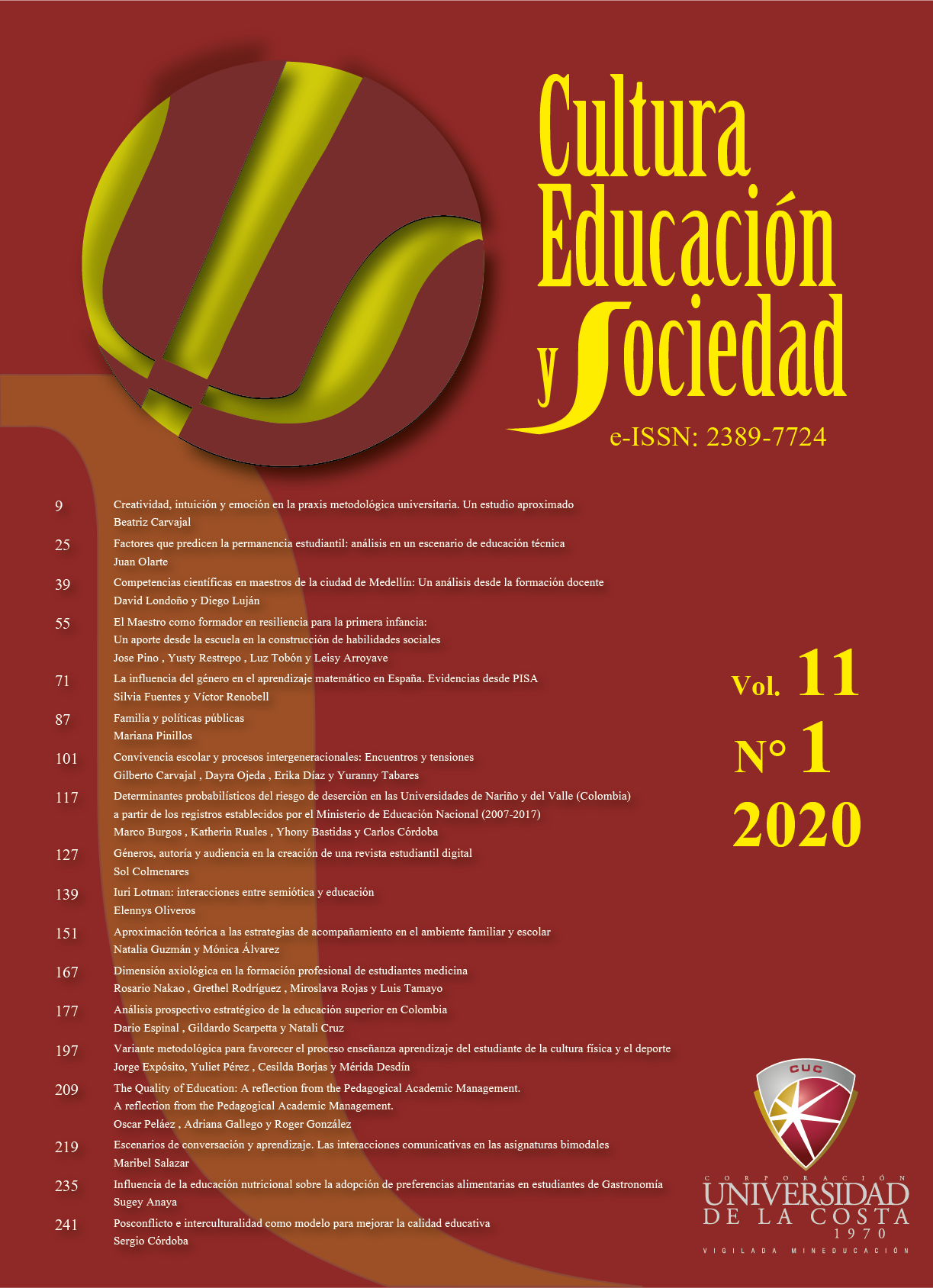
Gender influence on mathematical performance in Spain. Evidence from Programme for International Student Assessment
Article Sidebar
Main Article Content
Abstract
Different studies show how the gender factor is a variable that affects mathematical performance. This article investigates the existence and evolution of a gender gap in mathematics learning in Spain, based on the results of the evaluation of the Programme for International Student Assessment (PISA) in all its editions. The mathematical competence of Spanish students is also assessed, without any gender difference. A literature review of the last 30 years and a multisectoral analysis of the data provided by the PISA reports have been carried out. In the historical record the results highlight a better performance by competence in students of the male gender. On the other hand, the most current findings indicate a remarkable improvement in mathematical performance by Spaniards, in this case, without distinction of gender. It is concluded in the need to deepen the understanding of the internal self-concept and to go beyond the own social constructions to diminish the gaps between the different genders in the referred tests.
Downloads
Article Details

This work is licensed under a Creative Commons Attribution-NonCommercial-NoDerivatives 4.0 International License.

Creative Commons 2020 CULTURA EDUCACIÓN Y SOCIEDAD
This article is under international license Creative Commons Reconocimiento-NoComercial-SinObrasDerivadas 4.0.
The published articles are the sole responsibility of their authors and do not necessarily reflect the opinions of the editorial committee.
CULTURA EDUCACIÓN Y SOCIEDAD respects the moral rights of its authors, who assign to the editorial committee the patrimonial rights of the published material. In turn, the authors inform that this work is unpublished and has not been previously published.
All articles are under a:
Licencia Creative Commons Atribución-NoComercial-SinDerivadas 4.0 Internacional.