Exoskeleton for lower limb rehabilitation with two degrees of freedom aimed at patients with cerebrovascular accidents
Article Sidebar
Main Article Content
 https://orcid.org/0000-0002-4498-596X
Abstract
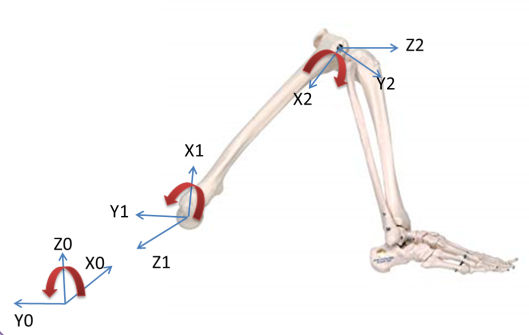
Introduction: An exoskeleton can be defined as a mechatronic structure that can be coupled to a limb externally and that allows the development of movements in the different joints of the same. These movements are developed with the support of actuators who are the ones who define the degrees of freedom of this type of devices. Although there are some important developments in this area, this is still in the research phase and many of the developments are not yet available or are not available for mass use in countries such as Colombia and Latin America in general.
Objective: This work presents the development of an active exoskeleton, which was designed to help in the rehabilitation of patients who have had some type of sequela as a result of an accident vascular brain (CVA), also known as stroke.
Methodology: Information on the modeling, design, control, and construction of the exoskeletal device as well as the development of preliminary tests are included and aimed at showing its use in the development of repetition tests in the sagittal plane.
Results: As a result, a functional prototype was done and validated in laboratory tests. From these experimental validations, it was possible to observe how the system works by moving the joints during a therapy process based on repetition exercises.
Conclusions:The developed system presents some features and elements that may be useful in the rehabilitation of patients with stroke, among them are the following: development of an automated rehabilitation monitoring system, mechanical design which results in a structure adjustable to different types of patients, modeling of the system and development of automatic control system as well as ease of use of interface developed in Labview.
Downloads
Article Details

This work is licensed under a Creative Commons Attribution-NonCommercial-NoDerivatives 4.0 International License.
Published papers are the exclusive responsibility of their authors and do not necessary reflect the opinions of the editorial committee.
INGE CUC Journal respects the moral rights of its authors, whom must cede the editorial committee the patrimonial rights of the published material. In turn, the authors inform that the current work is unpublished and has not been previously published.
All articles are licensed under a Creative Commons Attribution-NonCommercial-NoDerivatives 4.0 International License.
