
Important elements of the automotive supply chain in Colombia
Article Sidebar
Main Article Content
 https://orcid.org/0000-0002-0179-3319
Abstract
Introduction: Globalization has been a major aspect for the development of the Supply Chain (SC) paradigm, which seeks to minimize production costs and maximize the supply of goods with competitive advantages, in terms of economies of scale and labor. The automotive industry is the object of permanent study, due to the competitive context of the industry growth over time, by various factors including environmental impact, mobility, customization, increased direct and indirect competition, social changes and risk management.
Objective: This project seeks to highlight the importance and characterize the CA of the automotive sector in a developing country such as Colombia.
Method: The study was carried out using a methodology composed of the following steps: Step 0. Provide the global and domestic economic and social context of the CA; Step 1. Identify the stages, steps, and linkages of the CA; Step 2. Describe the added value of CA agents and components; Step 3. Describe the specificities of CA performance, and Step 4. Diagnosis and conclusions about the condition of the CA.
Results: The automotive and motorcycle sectors account for 4% of Colombia's gross industrial production and the capital city is the main contributor to the generation of employment at the national level, in addition to concentrating on three major axes: vehicle assembly, production of auto parts and assembly of motorcycles.
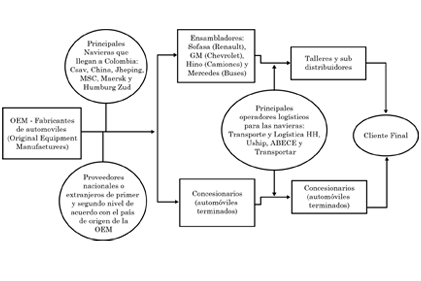
Conclusions: There are two important chains for the automotive sector; the import of finished vehicles (assembly outside Colombia) and automobiles assembled within the country. And for Colombia, the main challenge of the distribution of imported brands is product support, after-sales service, and spare parts throughout the national geography.
Downloads
Article Details

This work is licensed under a Creative Commons Attribution-NonCommercial-NoDerivatives 4.0 International License.
Published papers are the exclusive responsibility of their authors and do not necessary reflect the opinions of the editorial committee.
INGE CUC Journal respects the moral rights of its authors, whom must cede the editorial committee the patrimonial rights of the published material. In turn, the authors inform that the current work is unpublished and has not been previously published.
All articles are licensed under a Creative Commons Attribution-NonCommercial-NoDerivatives 4.0 International License.
