
Dinámica de micronutrientes en avena negra y maíz alimentados con polvo de roca dacítica y lodos lácteos en un suelo tropical
Barra lateral del artículo
Contenido principal del artículo
Resumen
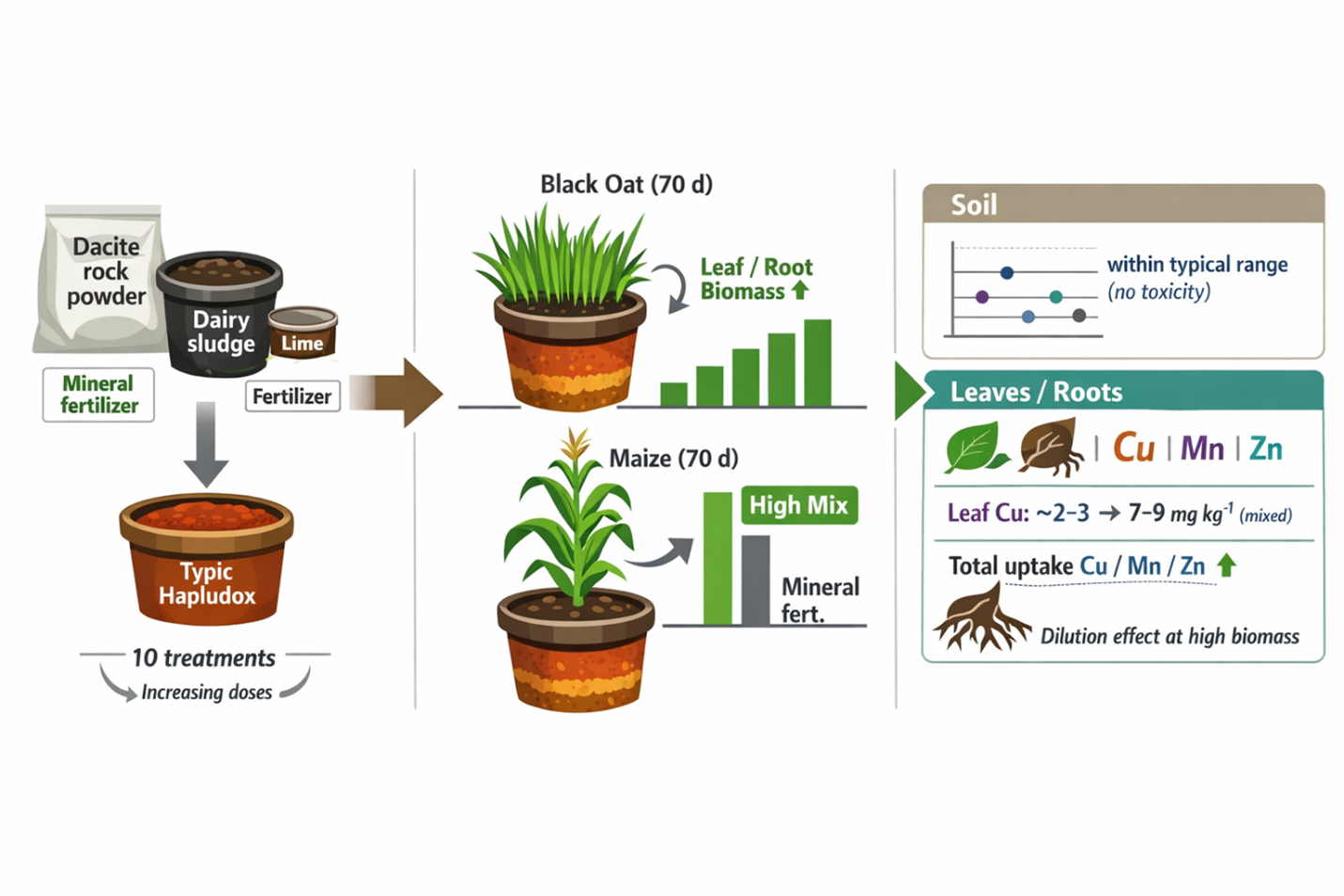
Los polvos de roca y los subproductos orgánicos se consideran cada vez más como fuentes alternativas de nutrientes en los sistemas de cultivo sostenibles, pero sus efectos en el suministro de micronutrientes y su posible toxicidad siguen estando mal documentados. Este estudio en invernadero evaluó la dimensión de micronutrientes de una estrategia de fertilización basada en polvo de roca dacítica y lodos lácteos que previamente habían demostrado mejorar la química del suelo y el suministro de macronutrientes para la avena negra y el maíz. Un suelo típico Hapludox recibió diez tratamientos que combinaban encalado, fertilizantes minerales, polvo de roca dacítica y lodos lácteos en dosis crecientes. La avena negra y el maíz se cultivaron secuencialmente en las mismas macetas durante 70 días cada uno. Se analizaron muestras de suelo poscosecha para determinar cobre (Cu), manganeso (Mn) y zinc (Zn) extraíbles, y se analizaron los tejidos de las hojas y las raíces para determinar las concentraciones de Cu, Mn y Zn. La absorción de micronutrientes se estimó combinando las concentraciones en los tejidos con la producción de materia seca. Las mezclas de polvo de roca dacita y lodos lácteos aumentaron la biomasa de hojas y raíces de ambos cultivos, con la materia seca de las hojas de maíz excediendo la del tratamiento de fertilizante mineral en la dosis mixta más alta. El Cu, Mn y Zn del suelo se mantuvieron dentro de los rangos típicos de los suelos tropicales meteorizados, y las concentraciones foliares de los tres micronutrientes se mantuvieron dentro de los rangos de suficiencia aceptados, sin indicación de toxicidad. En el maíz, los tratamientos mixtos corrigieron una deficiencia latente de Cu observada en las plantas de control encaladas, aumentando las concentraciones foliares de Cu de valores cercanos a 2-3 mg kg⁻¹ a aproximadamente 7-9 mg kg⁻¹. La absorción total de Cu, Mn y Zn por planta aumentó con dosis más altas de subproductos, a pesar de las disminuciones en algunas concentraciones tisulares en los niveles más altos de biomasa, lo que indica un efecto de dilución de nutrientes en lugar de una deficiencia emergente. Las concentraciones de Mn en las raíces aumentaron más fuertemente que las de Mn en las hojas, especialmente en el maíz, lo que sugiere la retención radicular como un mecanismo de tolerancia que limitó la acumulación excesiva de Mn en los brotes. En general, el uso combinado de polvo de roca de dacita y lodos lácteos favoreció el suministro de macronutrientes y micronutrientes a la avena negra y al maíz sin crear restricciones toxicológicas detectables en las condiciones probadas.
Descargas
Detalles del artículo

Esta obra está bajo una licencia internacional Creative Commons Atribución-NoComercial-SinDerivadas 4.0.

Usted es libre de:
- Compartir — copiar y redistribuir el material en cualquier medio o formato
- La licenciante no puede revocar estas libertades en tanto usted siga los términos de la licencia
Bajo los siguientes términos:
- Atribución — Usted debe dar crédito de manera adecuada , brindar un enlace a la licencia, e indicar si se han realizado cambios . Puede hacerlo en cualquier forma razonable, pero no de forma tal que sugiera que usted o su uso tienen el apoyo de la licenciante.
- NoComercial — Usted no puede hacer uso del material con propósitos comerciales .
- SinDerivadas — Si remezcla, transforma o crea a partir del material, no podrá distribuir el material modificado.
- No hay restricciones adicionales — No puede aplicar términos legales ni medidas tecnológicas que restrinjan legalmente a otras a hacer cualquier uso permitido por la licencia.
Link: https://creativecommons.org/licenses/by-nc-nd/4.0/deed.es