
Proposal for an Artificial Neural Network Model to Predict the Success or Failure of Projects Based on the PMBOK Approach
Article Sidebar
Main Article Content
Abstract
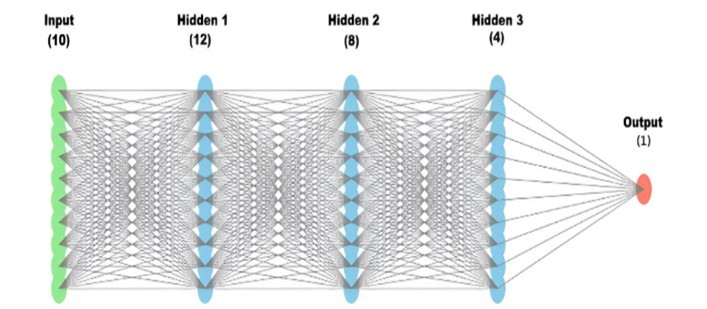
Globally, companies and organizations are increasingly implementing methodological tools or best practice standards for project management, such as PMBOK; however, it is important to recognize that, given the robustness of these approaches, a high level of expertise is required from project managers. In this context, the use of predictive tools can contribute to informed decision-making across the different stages of the project life cycle. Thus, this study proposes as its main contribution a novel model based on neural networks for predicting the success or failure of a project managed under PMBOK, using project features such as the resources involved, the project group according to PMBOK, and project indicators. For the development of this work, an adaptation of the CRISP-DM methodology into four phases was carried out. As a result, the model achieved consistent fitting over 100 training epochs, reaching an accuracy above 95% after 60–70 epochs, which suggests excellent fitting and generalization capabilities in predicting project outcomes. In conclusion, the model represents a key contribution to project management under PMBOK, with its differential factor being the inclusion of resources, the project group attribute, and the vector representation of qualitative project features identified within the indicator attribute.
Downloads
Article Details

This work is licensed under a Creative Commons Attribution-NonCommercial-NoDerivatives 4.0 International License.
Published papers are the exclusive responsibility of their authors and do not necessary reflect the opinions of the editorial committee.
INGE CUC Journal respects the moral rights of its authors, whom must cede the editorial committee the patrimonial rights of the published material. In turn, the authors inform that the current work is unpublished and has not been previously published.
All articles are licensed under a Creative Commons Attribution-NonCommercial-NoDerivatives 4.0 International License.
