
A reproducible layered directed acyclic graph protocol for secondary-data studies
Article Sidebar
Main Article Content
Abstract
Introduction: Secondary-data studies (clinical, administrative or sensor records) embed selection, measurement and missing-data processes that are often treated as “preprocessing”, leaving key causal assumptions implicit and hard to audit.
Objective: To propose a reproducible protocol that makes causal assumptions explicit in secondary-data studies using layered directed acyclic graphs.
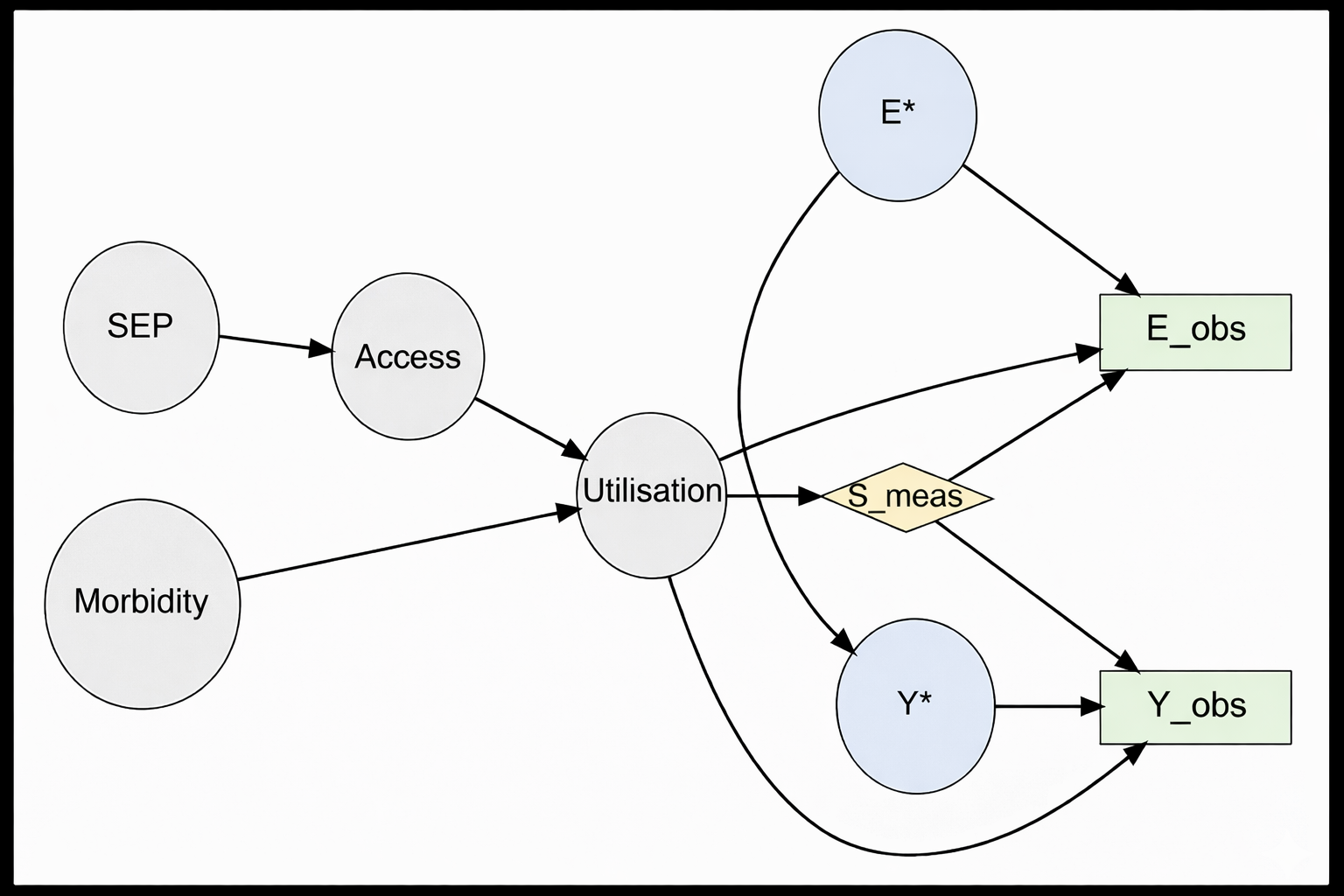
Methodology: The protocol separates a material causal system (exposure→outcome) and three additional layers: (i) selection/observability, (ii) operationalisation and measurement (constructs vs. recorded proxies) and (iii) missing-data mechanisms. It includes estimand and time alignment, extraction rules and cohort construction, plus quality control based on graph source code and figure traceability.
Results: Outputs include a reporting checklist (Table 1), a decision→threat→graph-signature mapping with conditional mitigations (Table 2), a related-work gap synthesis (Table 3), layered DAG examples (Figs. 1–9) and reproducible evaluations quantifying typical biases and sensitivity to missingness (Tables 4–7).
Conclusions: The layered approach makes selection, measurement and missingness assumptions explicit; improves reproducibility through code–figure–text traceability; and operationalises alignment between design/analysis choices and the estimand, limiting claims that exceed the available evidence. A minimal applied case shows that observation/missingness decisions can materially shift the estimand, motivating explicit sensitivity reporting (Δ) and denominators.
Downloads
Article Details

This work is licensed under a Creative Commons Attribution-NonCommercial-NoDerivatives 4.0 International License.
Published papers are the exclusive responsibility of their authors and do not necessary reflect the opinions of the editorial committee.
INGE CUC Journal respects the moral rights of its authors, whom must cede the editorial committee the patrimonial rights of the published material. In turn, the authors inform that the current work is unpublished and has not been previously published.
All articles are licensed under a Creative Commons Attribution-NonCommercial-NoDerivatives 4.0 International License.
