
Decoupled Trajectories: Fossil Co₂ Intensity, Land-Use Emissions, and Forest Dynamics in South America (2000–2020)
Article Sidebar
Main Article Content
Abstract
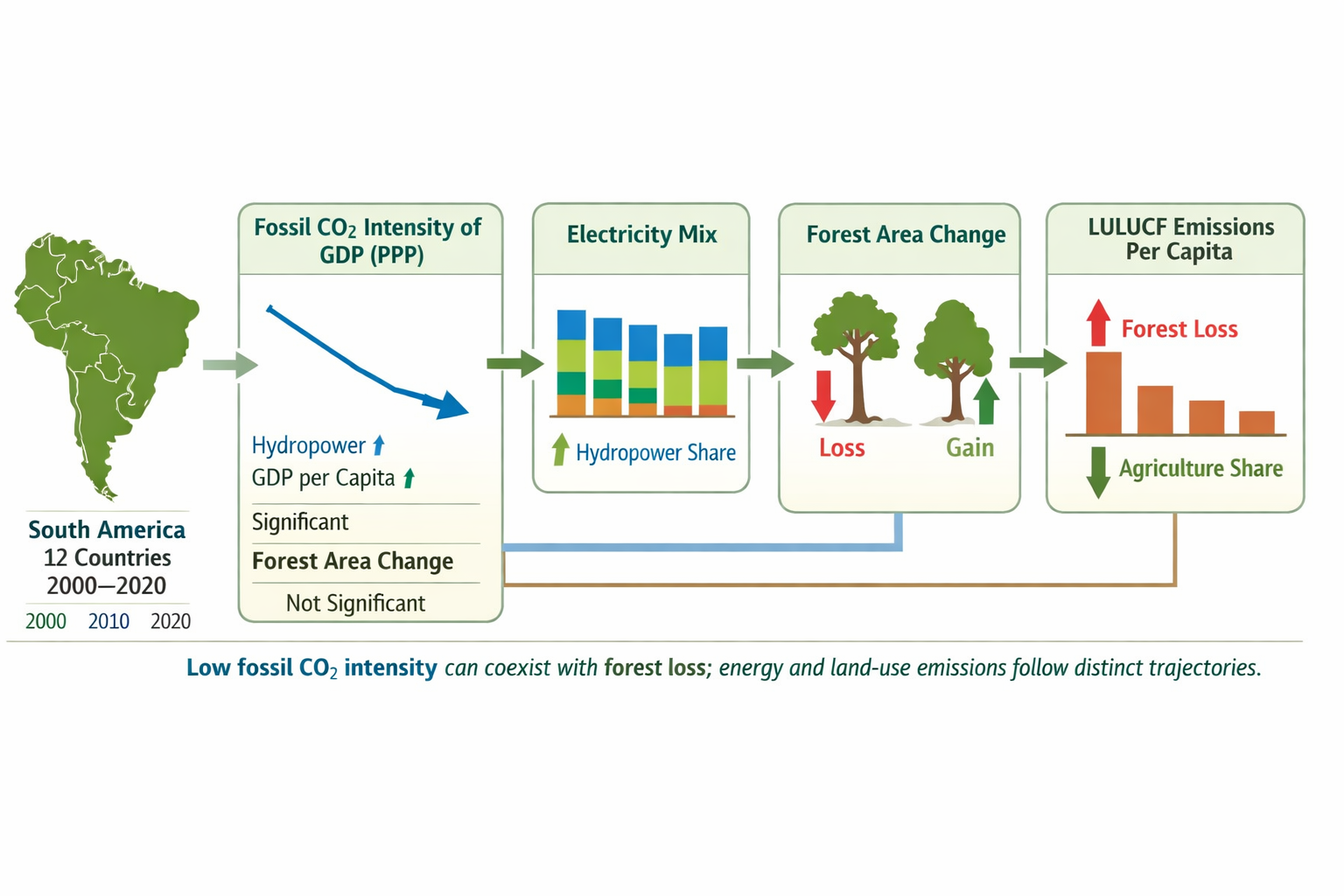
South America combines extensive tropical forests and large land‑use carbon stocks with an energy system that is relatively low in fossil CO₂ intensity, due in part to widespread use of hydropower. Conventional indicators of climate performance, such as fossil CO₂ emissions per unit of GDP at purchasing power parity, therefore, capture only part of the region’s greenhouse gas dynamics and risk overlooking land‑use, land‑use change, and forestry (LULUCF) emissions. This article examines how forest area, fossil CO₂ intensity of GDP, LULUCF emissions, and the electricity mix co‑evolved in twelve South American countries between 2000 and 2020. Using harmonised country–year data from regional and international statistical agencies, we construct a small panel for 2000, 2010 and 2020, derive decadal changes for 2000–2010 and 2010–2020, and estimate linear regressions that relate decadal changes in fossil CO₂ intensity and in per‑capita LULUCF emissions to changes in forest area, the hydropower share of electricity generation, GDP per capita and the agriculture value added share of GDP. The analysis shows that fossil CO₂ emissions per unit of GDP declined in most countries and that these reductions are significantly associated with increases in the hydropower share and with gains in GDP per capita, whereas decadal percentage changes in forest area are not significantly associated with changes in fossil CO₂ intensity once energy and income dynamics are taken into account. In contrast, decadal changes in per‑capita LULUCF emissions are closely associated with forest area dynamics and with changes in the agriculture share of GDP: greater forest loss is linked to larger increases in per‑capita LULUCF emissions, while declines in the agriculture share of GDP are associated with more favourable LULUCF trajectories. Simple regional groupings of countries show that low or declining fossil CO₂ intensity of GDP can coexist with continued forest loss. Taken together, the results indicate that energy‑sector decarbonisation and land‑use emissions follow distinct, though interconnected, trajectories in South America and that assessments of climate performance that rely solely on fossil CO₂ intensity of GDP may overstate mitigation progress in forest‑rich economies.
Downloads
Article Details

This work is licensed under a Creative Commons Attribution-NonCommercial-NoDerivatives 4.0 International License.

You are free to:
- Share — copy and redistribute the material in any medium or format
- The licensor cannot revoke these freedoms as long as you follow the license terms.
Under the following terms:
- Attribution — You must give appropriate credit , provide a link to the license, and indicate if changes were made . You may do so in any reasonable manner, but not in any way that suggests the licensor endorses you or your use.
- NonCommercial — You may not use the material for commercial purposes .
- NoDerivatives — If you remix, transform, or build upon the material, you may not distribute the modified material.
- No additional restrictions — You may not apply legal terms or technological measures that legally restrict others from doing anything the license permits.